No One Innovates Their Way Out of a Delivery Problem
 Aviv Ben-Yosef · 4 min read
The CTO who wasn’t making real progress for months didn’t understand why things were so hard. Like trying to build on quicksand, it felt like they were being pulled two steps back for every step forward.
Some tech leaders find themselves trying to run before they can walk. They talk big game about innovation, AI utilization, and novel approaches. But they’re barely hanging on. They forgot the engineering org’s pyramid of needs.
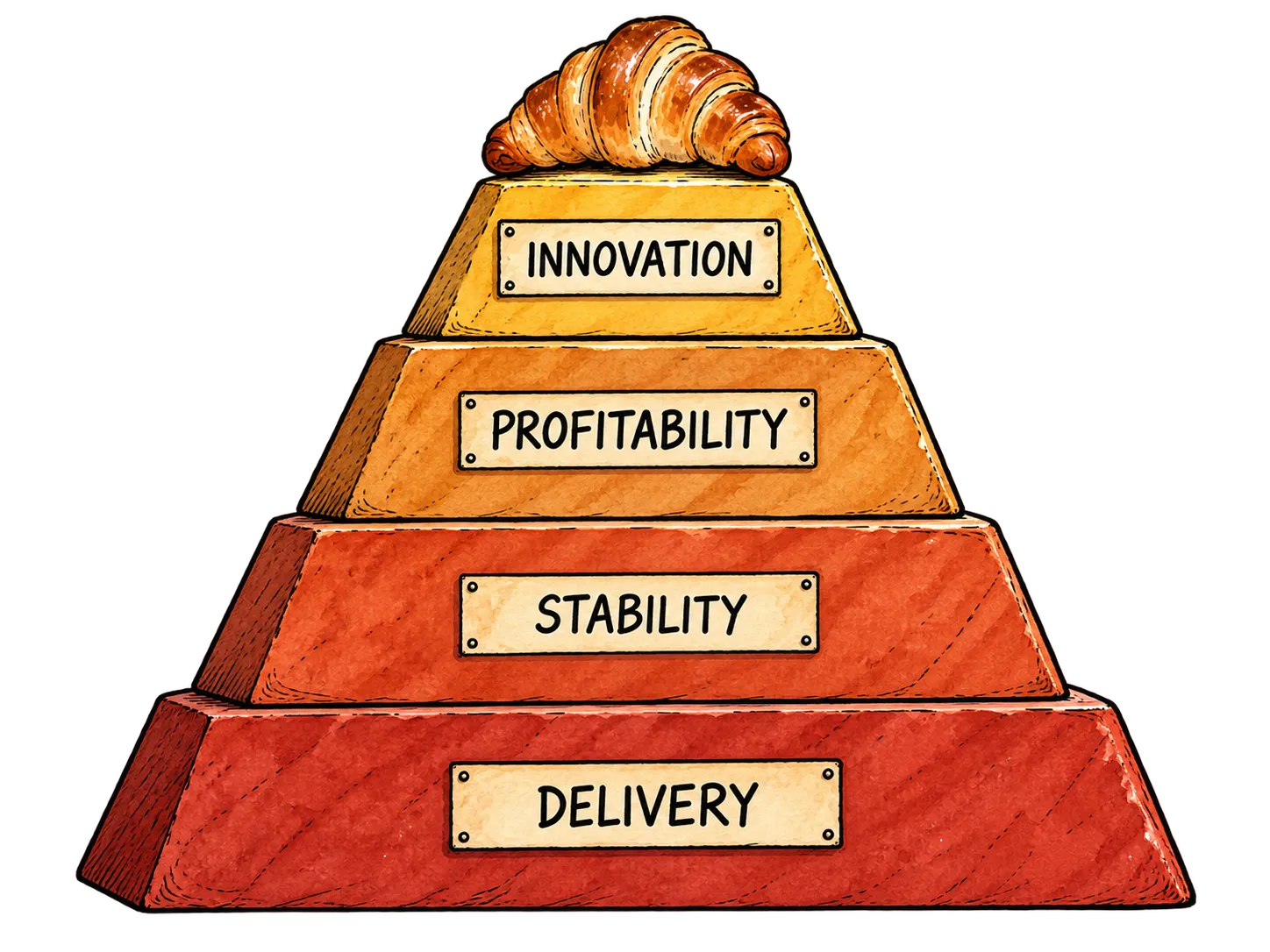
The Pyramid
There’s a basic hierarchy of things you need to get under control as you progress and move forward with your organization. Trying to do one while the foundational layers are still shaky is almost guaranteed to fail.
With many clients, I saw their frustration from not being at a higher rung without realizing that they are doing things prematurely. Wouldn’t we all prefer to be able to skip to the fun parts? However, when you embrace the pyramid, it gives you a clear path forward. Where are you at? Let’s go bottom-up.
Delivery
This is the very basic requirement from any engineering organization. If your team doesn’t deliver what’s needed, nothing else matters. Who cares about the scale of something that never ships? To have quality issues, you need to first have something built.
The basic premise is that many teams looking into doing things better are putting the cart before the horse. Get into a position where your team is relatively reliable and predictable, and can get things done. Optimization should only happen later.
For many, this is the hardest part, often because we don’t realize it is a prerequisite. If you need help with it, reach out.
Stability
When the team actually manages to ship things reliably, we move along. I will concede that for many, delivering well goes hand in hand with high stability. If your engineering hygiene practices are high, that’s often the case.
Nevertheless, we regularly see eng teams that struggle to live with what they just shipped out the door. The features might seem ok at first pass, but then a tsunami of edge cases, unexpected behaviors, and just bad UX make them drown.
Frequently, handling this layer of the pyramid requires close work with Product, as many of the gaps and stability issues can be traced to miscommunication and wrong assumptions right in that seam between Product and Engineering.
Profitability
By this I am not talking about the company’s profitability, which might be a ways off, but about building an engineering organization that can support that business’s growth reliably. This spans across things like scaling the architecture, making AI solutions not bleed money, creating an engineering organization that doesn’t have to scale linearly with the business’s growth, and more.
I go in-depth into this in the Profitable Engineering 101 ebook you can get here for free.
Innovation
Once you’ve got everything else already in order, you can finally start having fun with the sexy stuff. The reason real innovation is located here is based on the environment and the safety required to genuinely innovate, try something novel, and get our creativity muscles going.
As described in the sample chapter of The Tech Executive Operating System (get it here), good, diligent engineers tend to focus on getting the work done when things are too unstable. When we know a critical deadline is in danger (Delivery), or that there are critical bugs and fires to put out (Stability), it’s like we have horse blinders on.
Innovating, which means trying something that might not work out, requires safety and margin for experimentation. These are hard to come by in organizations that are still struggling in the lower layers of the pyramid.
How To Utilize It
With this understanding, you can leverage it to make rapid leaps in your organization’s capabilities. Working together with tech leaders who realize the business has grown faster than their organizations have, the pyramid gives us clarity.
First, assess your current situation and realize which level you’re at and where your major efforts need to be directed. I believe many of you can already easily place yourselves on that pyramid, but if you require another pair of eyes, reach out.
Then, put aside everything that’s related to the higher levels until you have things under control. Yes, it might feel frustrating at first, especially if it means putting on hold efforts you’ve already planned or even started. But it will be for the better. Channeling your attention and focus to make real progress in this single area, having a genuine priority, will make improvement easier, faster, and more rewarding.
Lastly, as you assess your progress and see that the trend is now going where you want it to go, you can start shifting your efforts to the next layer. Notice that I’m not saying you ought to have reached perfection before moving on. Getting to the 80/20 situation, where you feel confident, aren’t stressed about the upcoming steps, and can safely avert your gaze somewhere else, means you are ready to move on.
No one innovates their way out of a delivery problem. Find your current layer, fix that, and the ceiling becomes within reach. Up you go. Have fun storming the castle!